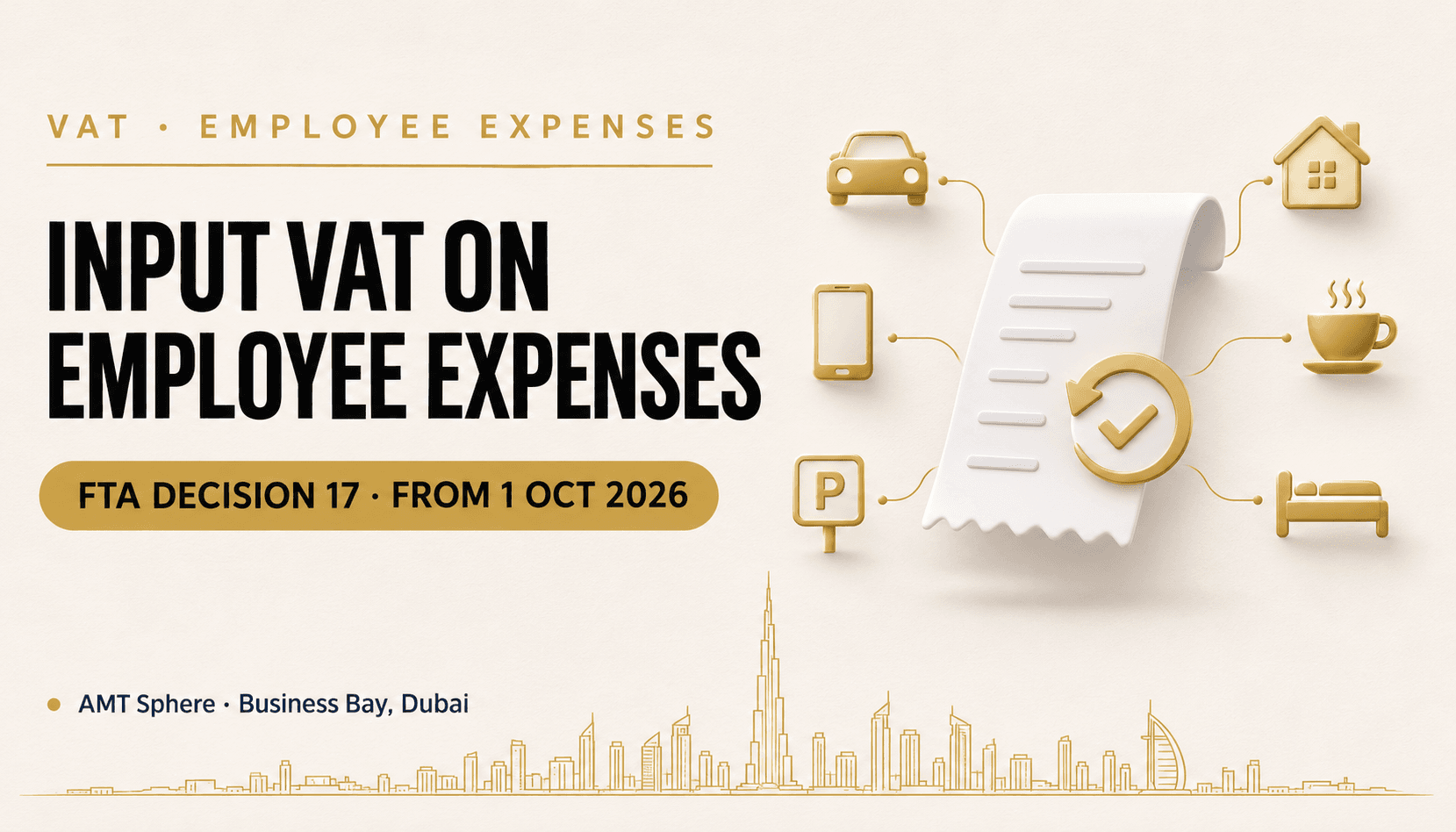
The short answer
From 1 October 2026, FTA Decision No. 17 of 2026 sets out six specific cases, each with its own conditions, in which a UAE business can recover input VAT on goods and services it provides to employees free of charge. A contractual obligation or a documented policy is the entry point, but it is no longer enough on its own: every condition for the relevant case must be met, and for transport, remote-area food and operational accommodation a cash-in-lieu option blocks recovery. Health insurance, accommodation that is mandatory under labour legislation, and deemed supplies are recoverable under their own separate routes. Any benefit that fits none of these starts from a position of non-recovery.
FREE GUIDE
Download the 2026 UAE Compliance Calendar
Every UAE tax, VAT and compliance deadline in one place. Free.
What changed on 1 October 2026
Until recently, recovery of input VAT on goods and services provided to employees was governed by a more general test in the VAT Executive Regulation. Recovery was available where providing the benefit was a legal or contractual obligation, or documented policy, and reflected normal business practice, which left a degree of room for interpretation. Cabinet Decision No. 149 of 2026, which amended the VAT Executive Regulation, replaced that broad wording and handed the Federal Tax Authority the task of specifying exactly when recovery is allowed.
FTA Decision No. 17 of 2026 is that specification. Issued on 9 September 2026 and effective from 1 October 2026, it operates under Article 53(1)(c)(2) of the VAT Executive Regulation and lists six cases in which input tax on goods or services provided to employees at no charge can be recovered, together with the conditions that must all be satisfied for each. The shift matters because it moves the test from a judgement call to a checklist. An expense that read as a reasonable business cost can now fail if a single listed condition is not met.
The six cases where input VAT can be recovered
Each case below is only available where all of its conditions are met. A contract or documented policy requiring the provision is assumed throughout.
Employee transport
Journeys between home and the workplace, to client or job sites, or other job-related travel. No personal use, and no cash allowance offered in place of the transport.
Food and beverages in remote areas
Provided to staff whose residence is in a remote, distant or isolated area with no preparation facilities and no restaurants readily available, tied to the required work or residence period. A remote work site alone is not enough; it is the employee’s residence that must be remote. No cash alternative.
Work-required accommodation
Housing provided for operational reasons, not as pay, where the role genuinely requires the employee to live close to the site. Generally employee-only and basic, with no significant recreational features, though the Decision recognises the case where the role requires the employee to reside permanently near the workplace and the accommodation is their usual residence. No cash option.
Temporary accommodation for new hires
For no more than 30 days, appropriate to the role and to basic residency needs while the employee settles in.
Mobile phones, airtime, data and home internet
Including a home modem or router the role genuinely needs. Personal use must be only incidental and insignificant, supported by a written usage policy that specifies permitted use and the consequences of unauthorised use, plus monitoring and records of any misuse.
Parking
Costs for business travel, client visits or the performance of job duties, supported by a documented reimbursement approval mechanism and receipts showing the date, time, amount and VAT paid.
The cases at a glance
| Employee cost | Core condition | Cash-in-lieu |
|---|---|---|
| Transport | Job-related journeys only, no personal use | Prohibited |
| Food and beverages | Employee’s residence remote or isolated, no nearby options | Prohibited |
| Work accommodation | Operational need to live near the site | Prohibited |
| New-hire accommodation | Temporary, 30 days maximum | No express condition |
| Mobile and internet | Business need, usage policy, monitoring | No express condition |
| Parking | Business or job-duty parking, approval and receipts | No express condition |
The conditions that run through every case
Three principles sit behind the detail. First, a contractual obligation or a documented policy requiring the business to provide the goods or service is the entry point: without one, none of the six cases apply. Second, the conditions within a case are cumulative, so meeting four out of five still means no recovery. Third, for employee transport, remote-area food and operational work accommodation there is an express condition that no cash alternative is offered; where the employee can take cash instead, recovery on the underlying cost is blocked because the provision is then treated as part of remuneration. For the other three categories there is no express cash-alternative condition, but a genuine option to take cash can still point to the benefit being remuneration, so the actual arrangement should be reviewed.
A valid tax invoice remains essential, and the wider input tax rules in the VAT Executive Regulation continue to apply on top of these conditions. Where part of a cost is recovered from the employee through a salary deduction, that deduction may itself be consideration for an underlying supply and needs its own VAT analysis; it does not automatically make the whole arrangement taxable, and this Decision is concerned with benefits provided free of charge.
Health insurance and the other recovery routes
The six cases are not the only way to recover input VAT on employee costs. Three separate routes sit alongside them and are easy to miss:
- ✓
Health insurance
Recoverable under its own provision, Article 53(1)(c)(3) of the VAT Executive Regulation, including enhanced cover, for the employee and eligible family members, being one spouse and up to three children under 18, subject to the wider input tax recovery requirements. This sits outside Decision 17 and is not affected by its six cases.
- ✓
Accommodation mandatory under labour legislation
A separate route allows recovery where accommodation is mandatory under UAE labour legislation, that is MoHRE decisions or directives. This route was restricted rather than removed: it applies where the provision is genuinely required under those rules.
- ✓
Deemed supplies
Where a benefit is treated as a deemed supply and output tax is accounted for, input tax recovery follows the deemed-supply rules rather than the six cases.
Our tax team at AMT Sphere, Business Bay, Dubai reviews your employee benefit lines against the six cases and the separate recovery routes, and flags where a missing policy, a cash option or an incomplete record is quietly costing you recoverable VAT.
Book a VAT recovery review →What the Decision does not cover
The six cases are a closed list. For free personal benefits, the starting position under Article 53 is non-recovery unless a specific exception applies: one of the six cases, the health-insurance entitlement, a provision that is mandatory under UAE labour legislation, or a deemed supply. A benefit that fits none of these is blocked, not merely left to a loose assessment. The errors we expect to see most often:
- ✗
Treating normal staff costs as automatically recoverable
Outside the six cases, the health-insurance entitlement, a MoHRE-mandated obligation or a deemed supply, the default is non-recovery. A cost being a normal part of employing people does not make its VAT recoverable.
- ✗
Treating entertainment, team meals or gifts as recoverable
Staff entertainment, team meals at an ordinary office and gifts often fall under blocked input tax, and are not brought into recovery by the new cases.
- ✗
Recovering where a prohibited cash option exists
For transport, remote-area food and operational accommodation, offering the employee cash instead blocks recovery.
- ✗
Thin records on phones, internet and parking
A mobile or internet policy that does not specify permitted use and the consequences of misuse, or that has no monitoring, will not support recovery. Nor will parking claimed without receipts showing the date, time, amount and VAT.
What to do before your next VAT return
- 01
List what you recover now
List every employee benefit and expense on which you currently recover input VAT.
- 02
Map each one to the six cases
For anything that maps, confirm all of that case’s conditions are met, not just the headline one.
- 03
Check the separate routes
For anything that does not map, check whether it falls under health insurance, a MoHRE-mandated obligation, or a deemed supply. If none apply, treat the starting position as non-recovery.
- 04
Review the actual arrangement
Confirm a contract or documented policy supports each provision. Where a cash alternative is involved, assess the real arrangement against all applicable conditions, rather than assuming that removing a cash option alone creates eligibility.
- 05
Fix the records
Put in place a mobile and internet usage policy that specifies permitted use, the consequences of misuse and monitoring, and collect parking receipts showing date, time, amount and VAT.
- 06
Apply it forward, review the past separately
Apply the conditions from the 1 October 2026 period onward. As its own exercise, review historical claims for any errors under the rules that applied at the time; the new conditions are not a retrospective reassessment of earlier periods.
Frequently asked questions
When did FTA Decision 17 of 2026 take effect?↓
Is a contract or policy enough on its own to recover the VAT?↓
Which employee expenses can I recover input VAT on under the Decision?↓
Does offering a cash allowance affect recovery?↓
Can I still recover VAT on staff health insurance?↓
What records do I need to support recovery?↓
Get your employee expense VAT right from October 2026.
AMT Sphere reviews your employee benefit lines against FTA Decision 17 and the separate recovery routes, fixes the policies and records, and keeps your input tax recovery clean. VAT, corporate tax and compliance, handled from Business Bay, Dubai.
Book a VAT recovery review →Available Mon–Fri, 9am–6pm GST